
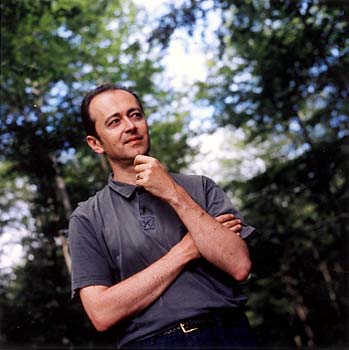
Inaspettata e curiosa - come ogni cosa lo riguardi, peraltro - la playlist che Louis Philippe presenta per il mese di aprile 2006. Ecco il testo:
Many charges can be brought against Led Zeppelin. Plagiarism, as Bert Jansch and the late Willie Dixon found out; ridiculous haircuts; a rather nasty streak of misogyny in lyrics that, most if not all the time, would make a 16-year-old diarist blush (and not just because of their content); misuse of violins (though not on Kashmir); drum solos; and please feel free to exercise your teeth on other bones of contention. But, speaking of bones, of all the skeletons that have been rattling in my cupboard for as long as I can remember (and I do – 1971, Led Zeppelin III), none have made such a din as the baddest hard-rock band of them all. As if they’d been characters from The Corpse Bride copulating on a tin roof, to misquote Sir Thomas Beecham.
Why is it that the delicate, sensitive, popsmith that I’m told I am still fishes out one of his copies (note the plural) of ‘Houses of the Holy’ when little else will do?
Good question. This is what I’ll try and answer now, remembering at long last a promise I made quite a while ago.
I should say straight away that I am in fairly good company when I confess to my love for Led Zep. My friend Saeko Suzuki, as fearsome on a drum kit as she is deliciously refined in real life, swears by them. So does, or so has in my presence, the Hon. Andy Partridge. Even more interestingly, the extraordinary Rob Kloet (the rhythm man in the Nits musical circus of wonders) will not stop eulogising if you mention the name of John Bonham to him, as I did after the Dutch band’s recent gig at Bush Hall. Rob’s ‘drumming’ had had me close to tears after a few bars. Such lightness, such economy, such power. His bass drum was the size was an orchestral grosse caisse – ‘just like John Bonham’s’, he said afterwards around a bottle or two of Shiraz. That cue was enough to launch me into a near-rant about the great man, encouraged as I was by Rob’s remarks, such as: ‘Bonham played up, not down’. Yes, I could see – hear – what he meant. ‘Up’.There was something spiritual about the violence of Bonham’s playing, and genuinely so. Led Zep’s secret was his as much as Plant’s and Page’s and Jones’s.
It is this ‘upness’ of Bonham’s that explains why one of the tracks I keep going back to is ‘The Ocean’, in itself a fairly run-of-the-mill rocker written by Plant about his young daughter, I’m told. Run-of-the-mill – until Bonham unleashes a volley of mini-breaks on the song’s bridge, his snare rolls cunningly combined with down-slides on Page’s guitar. I do not know of any more brutally elemental moment in the whole history of rock’n’roll; and, as with all great music, the effect of it is not blunted by repetition; on the contrary, it has acquired a granite-like awesomeness to me. I can feel it thud in my ears – but I’m not just punched senseless – I can also feel elevated, as if I’d gulped a big lungful of free air and expanded like a balloon.
Some of you may ask what I had for lunch after reading this. Nothing untoward, I promise you. I ‘d warned you – this skeleton makes a lot of noise.
However, if Bonham’s playing is one key (ha – those cross-rhythms on Black Dog…), it is not the only one with works that particular lock open.
Thirty-five years on, when so much of the huff and puff of that era has dwindled to nothing more than a rabbit’s fart on a tarpaulin (ask your French friends where this image comes from), these records have retained their capacity to shock, surprise and seduce. I’m no great fan of the first two, I’ll admit; too much heavy-arsed rock-blues in there for my own taste. For it is (to me, at least) when LZ becomes angular like a Chinese banjo that we’re in for the magic trip. The physical power of their music has much to do with its abstraction. I’m extremely surprised that no-one has ever remarked on the remarkably ‘modernist’ approach to track-construction and, more generally, sound treatment Page adopted on ‘Presence’, one of the most under-rated albums in the rock’n’roll canon. It is black music – as in ‘starless and Bible-black’, from which every hint of ornamentation has been taken off. Even Plant’s ludicrous (and thrilling) vocalising has lost any hint of corporeity; Page, it seems, slowed down the master tapes in order to make his singer gain half-a-tone or more when the tracks were played back at normal speed. Even the guitarist’s brief interjections seem sculpted in a matter that is both hard to the touch – with a grit of its own – and preternaturally smooth to the mind’s eye. Do listen to ‘Presence’ again if you can; and you may agree with me (and my friend Michka Assayas, another great admirer of this opus) that there is little that people find in Joy Division’s Unknown Pleasures that cannot be found in a single bar of Achille’s Last Stand, despite the pretentiousness of its title.
For those of a less austere disposition (Presence can be hard work), The Song Remains The Same (the track, not the very ordinary live album of the same name) could be an entry point in Led Zep’s rather bleak but astonishing soundscape. I’ve often played the intro to this song to unsuspecting listeners, as well as the tour-de-force of Page’s carefully-constructed riffing in its coda. ‘What the hell is this?’ tends to be the reaction. And ‘what?’ the comment, after I’ve answered the query. Led Zep, it seems, should sound like Spinal Tap, not like this.
Nor should it sound like ‘Going To California’, a ravishing song which was somehow forgotten in the explosion of ‘IV’; or ‘Gallows Pole’, and most of the B-Side of III, which was written by someone – Page – who could hear things in English folk music that no-one had heard before. Seriously.
In the end, it is all down to prejudice, isn’t it? How could three hairy sessionmen and a hairier vocalist produce something worth hearing three-and-a-half decades later? I learnt long ago that this kind of question wasn’t worth asking. And I also learnt that I oughtn’t be ashamed to have – almost – played air guitar to ‘Misty Mountain-Hop’ in my boarding-school dormitory. Do join in, please. There’s room for a few more people yet.
Louis
Why is it that the delicate, sensitive, popsmith that I’m told I am still fishes out one of his copies (note the plural) of ‘Houses of the Holy’ when little else will do?
Good question. This is what I’ll try and answer now, remembering at long last a promise I made quite a while ago.
I should say straight away that I am in fairly good company when I confess to my love for Led Zep. My friend Saeko Suzuki, as fearsome on a drum kit as she is deliciously refined in real life, swears by them. So does, or so has in my presence, the Hon. Andy Partridge. Even more interestingly, the extraordinary Rob Kloet (the rhythm man in the Nits musical circus of wonders) will not stop eulogising if you mention the name of John Bonham to him, as I did after the Dutch band’s recent gig at Bush Hall. Rob’s ‘drumming’ had had me close to tears after a few bars. Such lightness, such economy, such power. His bass drum was the size was an orchestral grosse caisse – ‘just like John Bonham’s’, he said afterwards around a bottle or two of Shiraz. That cue was enough to launch me into a near-rant about the great man, encouraged as I was by Rob’s remarks, such as: ‘Bonham played up, not down’. Yes, I could see – hear – what he meant. ‘Up’.There was something spiritual about the violence of Bonham’s playing, and genuinely so. Led Zep’s secret was his as much as Plant’s and Page’s and Jones’s.
It is this ‘upness’ of Bonham’s that explains why one of the tracks I keep going back to is ‘The Ocean’, in itself a fairly run-of-the-mill rocker written by Plant about his young daughter, I’m told. Run-of-the-mill – until Bonham unleashes a volley of mini-breaks on the song’s bridge, his snare rolls cunningly combined with down-slides on Page’s guitar. I do not know of any more brutally elemental moment in the whole history of rock’n’roll; and, as with all great music, the effect of it is not blunted by repetition; on the contrary, it has acquired a granite-like awesomeness to me. I can feel it thud in my ears – but I’m not just punched senseless – I can also feel elevated, as if I’d gulped a big lungful of free air and expanded like a balloon.
Some of you may ask what I had for lunch after reading this. Nothing untoward, I promise you. I ‘d warned you – this skeleton makes a lot of noise.
However, if Bonham’s playing is one key (ha – those cross-rhythms on Black Dog…), it is not the only one with works that particular lock open.
Thirty-five years on, when so much of the huff and puff of that era has dwindled to nothing more than a rabbit’s fart on a tarpaulin (ask your French friends where this image comes from), these records have retained their capacity to shock, surprise and seduce. I’m no great fan of the first two, I’ll admit; too much heavy-arsed rock-blues in there for my own taste. For it is (to me, at least) when LZ becomes angular like a Chinese banjo that we’re in for the magic trip. The physical power of their music has much to do with its abstraction. I’m extremely surprised that no-one has ever remarked on the remarkably ‘modernist’ approach to track-construction and, more generally, sound treatment Page adopted on ‘Presence’, one of the most under-rated albums in the rock’n’roll canon. It is black music – as in ‘starless and Bible-black’, from which every hint of ornamentation has been taken off. Even Plant’s ludicrous (and thrilling) vocalising has lost any hint of corporeity; Page, it seems, slowed down the master tapes in order to make his singer gain half-a-tone or more when the tracks were played back at normal speed. Even the guitarist’s brief interjections seem sculpted in a matter that is both hard to the touch – with a grit of its own – and preternaturally smooth to the mind’s eye. Do listen to ‘Presence’ again if you can; and you may agree with me (and my friend Michka Assayas, another great admirer of this opus) that there is little that people find in Joy Division’s Unknown Pleasures that cannot be found in a single bar of Achille’s Last Stand, despite the pretentiousness of its title.
For those of a less austere disposition (Presence can be hard work), The Song Remains The Same (the track, not the very ordinary live album of the same name) could be an entry point in Led Zep’s rather bleak but astonishing soundscape. I’ve often played the intro to this song to unsuspecting listeners, as well as the tour-de-force of Page’s carefully-constructed riffing in its coda. ‘What the hell is this?’ tends to be the reaction. And ‘what?’ the comment, after I’ve answered the query. Led Zep, it seems, should sound like Spinal Tap, not like this.
Nor should it sound like ‘Going To California’, a ravishing song which was somehow forgotten in the explosion of ‘IV’; or ‘Gallows Pole’, and most of the B-Side of III, which was written by someone – Page – who could hear things in English folk music that no-one had heard before. Seriously.
In the end, it is all down to prejudice, isn’t it? How could three hairy sessionmen and a hairier vocalist produce something worth hearing three-and-a-half decades later? I learnt long ago that this kind of question wasn’t worth asking. And I also learnt that I oughtn’t be ashamed to have – almost – played air guitar to ‘Misty Mountain-Hop’ in my boarding-school dormitory. Do join in, please. There’s room for a few more people yet.
Louis