
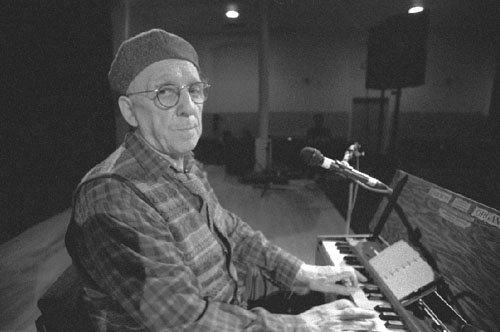
Few Scottish artists of any discipline can match the mystique or catalogue of works stretching over 5 decades of Glasgow born Ivor Cutler. A recording artist, poet, illustrator, performer, painter and composer - Cutler's unique and personal delivery is one of philosophical undertone and analysis of the absurdities of life.
Brief Biography
Born in 1923, Glasgow (Ibrox), to a middle class orthodox Jewish family. His upbringing was strict and austere, an experience which would provide endless subject matter for his later writings, although not without a hint of fondness - Cutler's love of purity and simplicity provides an unmoveable foundation for much of his work. As a child he endured the hardship of sharing his mother's love with a new baby brother who he felt received the most attention. Cutler would tell the story of once plotting to kill him, only to be caught just in time by his auntie. On the other hand, without the removal of his place as "favourite" of the family, he suggests he would not have gone on to be as creative as he is.
With Jewish parents he was able to read Hebrew but at school was unable to write English and to this day his writing is a trademark scrawl. He bore the brunt of anti-Semitic harassment from pupils and teachers alike (being given the strap on countless occasions). Cutler's struggle with his religion came to a head in his late teens after querying his priest on the existence of God. After leaving without a sufficient answer he decided to investigate other religions by visiting other churches. Having no luck, he became agnostic.
With Jewish parents he was able to read Hebrew but at school was unable to write English and to this day his writing is a trademark scrawl. He bore the brunt of anti-Semitic harassment from pupils and teachers alike (being given the strap on countless occasions). Cutler's struggle with his religion came to a head in his late teens after querying his priest on the existence of God. After leaving without a sufficient answer he decided to investigate other religions by visiting other churches. Having no luck, he became agnostic.
In 1939 and at the age of 16 he was evacuated to Annan of the south west coast of Scotland, although it is claimed he ran away. However a year later he could not run away from the call of King of Country and he was initially conscripted to work for Rolls Royce making engines for spitfires, and then later being drafted into RAF as a navigator. Cutler was no model crewman by any standard; his dreamy state and love for nature as opposed to combat ensured his time serving for his country was short lived. He spent the remaining part of the war working as a First Aid officer and storeman for the Windsor Engineering Company. He later married and had two children although the marriage did not last very long.
After the end of his conscription he became a teacher at the controversial school, Summerhill, in Suffolk, founded by A S Neill. Summerhill began in 1921 in Dresden Germany, later moving to Austria and then finally setting up a permanent residence in England in 1927 where it is still thriving today. The school is an ultra-liberal commune type establishment (a "free school") where pupils decide which subjects to study and when, and the rules of the school are decided by majority vote of the pupils attending. During this time Cutler felt free to ferment his socialist and humanitarian ideals, particularly in free thinking and being anti-competitive ..."I have avoided competitive situations, because I am not a baboon". In 1951 he moved on to work for the Inner London Education Authority, where he continued to teach in various positions until the 80s. During the 60s he taught music, movement, drama and poetry to 7-11 year olds. During this time it is thought that Cutler's inner spark for creative writing was kindled, a crucial time in his artistic development where making up stories, dance and music was part of the job. Now in his mid 30s, Cutler began writing material with a semi serious view to being published. At that time he was seriously thinking of leaving teaching, to be an artist, preferably a painter, and thought that writing for other people would bring in some extra cash. Now with a family to support, a career move seemed inevitable, however the path it took wasn't something even he imagined.
After the end of his conscription he became a teacher at the controversial school, Summerhill, in Suffolk, founded by A S Neill. Summerhill began in 1921 in Dresden Germany, later moving to Austria and then finally setting up a permanent residence in England in 1927 where it is still thriving today. The school is an ultra-liberal commune type establishment (a "free school") where pupils decide which subjects to study and when, and the rules of the school are decided by majority vote of the pupils attending. During this time Cutler felt free to ferment his socialist and humanitarian ideals, particularly in free thinking and being anti-competitive ..."I have avoided competitive situations, because I am not a baboon". In 1951 he moved on to work for the Inner London Education Authority, where he continued to teach in various positions until the 80s. During the 60s he taught music, movement, drama and poetry to 7-11 year olds. During this time it is thought that Cutler's inner spark for creative writing was kindled, a crucial time in his artistic development where making up stories, dance and music was part of the job. Now in his mid 30s, Cutler began writing material with a semi serious view to being published. At that time he was seriously thinking of leaving teaching, to be an artist, preferably a painter, and thought that writing for other people would bring in some extra cash. Now with a family to support, a career move seemed inevitable, however the path it took wasn't something even he imagined.
After a few years having his work rejected by publishers in London's Tin Pan Alley, he decided to perform the work himself. Almost immediately, things started to take a positive turn.In 1957 he began performing his own songs and in 1959 he was asked to perform on BBC Television's "Tonight" program. After the first broadcast, the producer was keen to have him back for future weeks, but it was decided that he was "too ahead of his time". Radio came to the rescue in the form of the BBC's Home Service on a show called "Monday Night at Home", a relationship that would last through to 1963. Along the way he began his recorded career via the Fontana label, an EP entitled "Ivor Cutler of Y'Hup", and later in 1961 a full length album and EP for Decca.The next four years are a bit of mystery (does anyone know?), but in 1967 he escalated the ladder of fame several steps after interest from a little band called The Beatles, who invited him to appear in their film (of particular bad quality), "Magical Mystery Tour". In it he plays the role of tour guide "Buster Bloodvessel", where he more or less plays himself with emphasis on the schoolmaster persona.Around the same time he recorded his first session for John Peel who would invite him back many times right up until Peel's demise.During the 70s and 80s Cutler was at his most productive with a string of albums for the fledgling Virgin label, one for the legendary Harvest label, and later Rough Trade. Along the way he worked with and became friends with a variety of other artists including Soft Machine (and later Robert Wyatt). Throughout this time he wrote ferociously, firstly with children's books in the 70s and then mostly poems and prose in the 80s.
Throughout his career he has performed regularly although appearances have slowed down during the 90s and the 21st century. His show in London in 2004, where he appeared clearly frail was his last.
Throughout his career he has performed regularly although appearances have slowed down during the 90s and the 21st century. His show in London in 2004, where he appeared clearly frail was his last.
The Works of Ivor Cutler
The most remarkable aspect of Ivor Cutler's recordings and poems is that for almost his entire career, the format and style of this output has remained constant, almost as if he realised his natural and instinctive forte early on and stuck to it with hardly any deviation. From the first EP on Fontana to his last LP for Rough Trade, one could transpose songs and stories from one into the other and have difficulty in spotting any obvious difference. One reason for this permanence is the fundamental tools of his trade: voice and harmonium. The harmonium, a foot or hand pumped organ, was already an archaic instrument when he first began recording in the 50s, and thus the timelessness was ensured. Cutler used the instrument with trademark effect, very often using a single chord to introduce a poem. Although he used a variety of instruments on other occasions (ranging from piano to weird and wonderful Nigerian instruments), the harmonium was the central sound throughout his recording career. When listening to Ivor Cutler one is quickly accustomed to the sound of his feet working the pedals back and forth to drive its pipe system.Style wise, it is obvious that Cutler is wise to all forms of music, which he has incorporated into songs: jazz, stage musical, baroque, nursery.
Ivor Cutler's subject matter, when scrutinised fairly closely is as complex as it is subtle. The words and delivery can seem nonsensical or gibberish, perhaps even verging on the insane. One has to take into account Cutler's time spent as a teacher to realise the source of his material and more importantly, the fact that his view of the world was the unadulterated viewpoint of a child. We can draw a majestic parallel with that of Einstein, where much of his theories were spawned from thinking from a child's perspective ... "what if?". A prime example is Cutler's play on words, particularly the failings of the English language, no doubt scrutinised while learning Hebrew as a child as well his family's adopted tongue. Examples such as the song "Traffic Jam" where he discusses the pros and cons of different types of jam (that which you eat), and "Shoplifters" where shop owners are offered help in literally lifting up their shop. One only has to present such a term to a child for the first time to realise the true absurdity of English, Cutler is merely making a point.His years of teaching, particularly during the 60s, laid the foundations for his creative talent, and also the style in which he delivered it. His classification of adults who dismiss his work are merely those who think in an adult way, and have lost the all important means of accepting the world through eyes of a child which one would argue, is the clearest. The manner in which his poems are read: with purpose, clarity and with accent on the consonants, resemble someone still attempting to learn the language, mixed with delivering clear instruction to a class. Even after moving on to performing, he likened the audience to a classroom of children, sitting quietly ready to be educated. In poetry, Cutler is keen to point out that the sound of words, and more simply the sound of speech, is just as important as the sentences themselves."You can see the Irish really enjoying it [my gigs], because the Celts are really keen on the noise that words make, the music that words make".When he was perfecting his poetry skills, before he ever decided he was any good at it, he would go to jazz nights in town and write words (some English some not), allowing the melodies and harmonies soak through his mind into the pen and onto the paper.
In interviews, Cutler is surprisingly open about his method of comedy and communication, pointing out that in order to convey comedy through stealth, rather than simply by telling jokes, one has to tap into the child within us all, which can often fail on those who present their adult mind as a barrier, and therefore only hearing the poem or story in its literal sense."People try to imitate me, but they think that all you have to do is be funny with a straight face. They don't realise that my humour is coming from my unconscious mind. If they want to be funny that's what they should be doing, but I don't think they know easily how to do it, because it's a bit tricky, you have to sneak past the intellect.""All the words that I use are just a vehicle like radio waves, a message from my unconscious to the unconscious of the listener. I don't know what I have communicated, and the listener doesn't know what is being communicated, but I am constantly being told by people 'I don't understand what you have just said, but I do feel I have been communicated with".In discussion with John Peel during his first every session, he slips in a comment on parents allowing children to read his books."I've been reading them to children and they appear to like them, but whether their parents are prepared to get rid of the artificial arbitrary strictures which prevent them from enjoying this kind of thing is another matter".Cutler's subject matter is far and varied, but there is a distinct section of his work which is semi-autobiographical. The most obvious is that of his childhood, particularly on the album and book "Life in a Scotch Sitting Room Part 2". Cutler paints an unreasonably dark picture of poverty and neglect from his parents, along with a stoicism that any monk would be proud of. In particular, he focuses on the individual's acceptance and gratitude for the most basic elements of life, nature and love. The prose is heavily spattered with references of how life in Scotland was in the 20s and 30s. The images are heavily exaggerated, and this is perhaps for two reasons, one being the writing allows him to vent the unprintable (such as the lack of motherly love), and the second is toying with the Scottish stereotype.
Another topic which features in his work is that of marriage, or more specifically the basis of relationships. In the song "Trouble Trouble", the lines go ..."Why don't a woman love a woman,And why don't a man love a man,For if woman love a man,It's trouble trouble trouble all the time"Cutler's marriage did not last very long, and perhaps the experience made him think long and hard about the fact that although men and woman attracted, they are rarely similar animals intellectually. Cutler's sentiments are in no way homosexual, merely realistic. It is known that he had a long term "relationship" with the writer Phyllis April King who appeared on many of his recordings in the 70s, but they never married, and obviously the modernist relationship suited them both.
Later Life
With very little output since the late 90s, it became known that during 2004 suffered ill health and was admitted to a nursing home. In March 2006 Ivor died. Ivor reached out with his philosophy through his broad catalogue of work that spans more decades and more major record labels than possibly any other recording artist known in the world. He will surely never be forgotten.
Long live Ivor Cutler.
The Cosmic Crofter, 2006.