
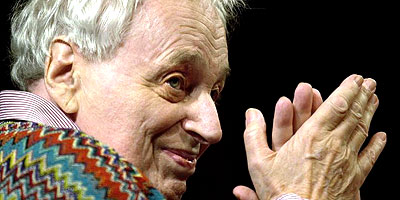
Malato da tempo, è morto due giorni fa a Vienna all'età di 83 anni György Ligeti, uno dei massimi compositori del ventesimo secolo. I suoi funerali sono annunciati per il 26 giugno, sempre a Vienna.
Eccone un breve ritratto, trovato oggi su Wikipedia:
Ligeti nacque a Dicsöszentmárton (ora Târnaveni) e ricevette le basi musicali al conservatorio di Kolozsvár (Cluj-Napoca), entrambe in Transilvania, Romania. La sua educazione fu interrotta nel 1943, quando, essendo ebreo, fu costretto ai lavori forzati dal partito nazista. Nello stesso periodo i suoi genitori, suo fratello e altri parenti furono deportati al campo di concentramento di Auschwitz; sua madre, l’unica sopravvissuta. Dopo la guerra, Ligeti riprese i suoi studi a Budapest, laureandosi nel 1949. Studiò con Pál Kadosa, Ferenc Farkas, Zoltán Kodály e Sándor Veress. Continuò il suo lavoro di musica etnica con la musica popolare romena, ma dopo un anno tornò alla sua vecchia scuola a Budapest, questa volta come docente di armonia, contrappunto e analisi musicale. Tuttavia le comunicazioni tra l’Ungheria e l’ovest vennero interrotte dal governo comunista di allora, e Ligeti dovette ascoltare segretamente le trasmissioni radio per tenersi aggiornato circa gli sviluppi musicali. Nel dicembre del 1956, due mesi dopo la repressione della rivolta ungherese attuata dall’esercito sovietico, fuggì a Vienna e infine ottenne la cittadinanza austriaca. Lì ebbe la possibilità di incontrare personaggi importanti di avanguardia dai quali venne isolato in Ungheria. Tra questi, i compositori Karlheinz Stockhausen e Gottfried Michael König, entrambi innovatori di allora dediti alla musica elettronica. Ligeti lavorò nel loro stesso studio, a Köln, e fu ispirato dai suoni che poteva creare lì. A ogni modo, produsse poca musica elettronica da sé, e non si concentrò su lavori strumentali che contenessero strutture elettroniche. Da questo momento, l’opera di Ligeti divenne maggiormente conosciuta e rispettata, e si potrebbe dire che le sue più note composizioni abbraccino il periodo che va da Apparitions (1958-9) a Lontano (1967), sebbene la sua ultima opera lirica, Le Grand Macabre (1978), sia pure molto famosa. In anni più recenti, i suoi tre libri per pianoforte Études sono diventati abbastanza noti grazie alle registrazioni di Pierre-Laurent Aimard, Fredrik Ullén, e altri. Nel 1973 György Ligeti ottenne una cattedra ad Amburgo, lasciata nel 1989. Dagli anni ‘80 ha dovuto sopportare i problemi di una cattiva salute, che ha rallentato la sua produzione, per quanto abbia continuato a scrivere. Ligeti ha anche espresso una passione per la geometria frattale di Benoît Mandelbrot, e gli scritti di Lewis Carroll e Douglas R. Hofstadter. Nel 2004 è uscito per la Alet Edizioni, collana Diorami, il libro-intervista di Eckhard Roelcke e György Ligeti "Lei sogna a colori?", ISBN 88-7520-005-X. György Ligeti è morto a Vienna il 12 giugno 2006 all'età di 83 anni.
On Monday morning, the Austrian-Hungarian composer György Ligeti died in Vienna at the age of 83 after suffering from a serious illness. With him, we have lost one of the greatest composers of the 20th century. György Ligeti was an adventurer in form and expression and a great visionary of contemporary music. His richly varied output takes a special position in its musical quality and uncompromising individuality. Ligeti moved far away from aesthetic trends and methods all his life. He was characterized by fresh and unorthodox ideas, any form of dogmatism was foreign to his nature, his entire oeuvre is marked by radical turning points. Admired and hugely influential in the profession, the sensual accessibility of his music has won the hearts of audiences everywhere. Atmosphères, the orchestral work he created in 1961, made Ligeti instantly well-known. In this piece, he worked almost completely without traditional melodic, harmonic and rhythmic parameters and concentrated on sounds with constantly changing textures. ‘Micropolyphony’, he once described, ‘means such a dense tissue that the individual parts become inaudible and only the resulting intermingling harmonies are effective as a form'. For him, however, techniques were never an end in themselves. Ligeti did not keep long to iridescent tonal surfaces, but always looked for new paths. His father and brother both died in concentration camps; he himself managed to escape the labour service of the Hungarian army in 1941 and had to flee to Austria after the Hungarian Revolution of 1956. Deeply affected by these events, he developed a strong dislike of any dictatorship and any form of intellectual restriction: 'I am an enemy of ideologies in the arts. Totalitarian regimes do not like dissonances.' Biochemistry, chaos research, fractal geometry – Ligeti, who initially intended to study physics, found inspiration in the natural world for new compositional principles. During his long years as a teacher of international repute, he encouraged the independence, originality and uncompromising self-criticism of his pupils: 'There is only one tradition. Our music either stands up to it or not.' After his intensive work at the Studio für elektronische Musik of the WDR in Cologne in the 1950s and the development of micropolyphony in the 1960s, his personal style became simpler and more transparent in the 1970s. And as if wanting to withdraw from the predominating musical tendencies, he began to use tonal sounds again. Ligeti said: 'I no longer listen to rules on what is to be regarded as modern and what as old-fashioned.' His only full-length stage work Le Grand Macabre was inspired by the theatre of the absurd and is teeming with operetta-like wit and black humour. The composer wanted to communicate more directly with audiences: 'Stage action and music should be dangerous and bizarre, absolutely exaggerated, absolutely crazy.' In the 1980s and 1990s, Ligeti expanded his musical horizons again, incorporating structural principles of African drumming music into his works: the fanatic of the intricate developed new complex polyrhythmic techniques. They form the basis of the 3 collections of his Études pour piano which are considered to be the most important piano music of the end of the 20th century. György Ligeti travelled a long road: from Romanian folk music and the tonal language of his fellow countryman Béla Bartók to his own cosmos of sounds. The mentor of a whole generation of composers, he wanted to 'fuse the fear of death with laughter'.